
Biology as a Pointer to the Divine
By Sy Garte
“Why?” we ask. “Why is there life, what is it, and how did it start?” We humans can and have learned a lot about life. We invented a science called biology. And in many cases, what we have learned only makes those enigmas we cannot resolve stand out more visibly.
We have seen that there is no clear reason that life should arise from a sea of chemicals. In fact, not only do we not know the answer to that question, we do know enough about chemistry and physics to be able to say, “There is no reason that life should exist.” We can exclude any scientific reason for the existence of life based on all the science we know. We can see there is no reason for anything to be alive. Where does this leave us?
We could just leave it at that and conclude that there is no “why” about life; it just is. But perhaps the answer is not to be found in the light under the lamppost we have been staring at. The light we are using to try to find the answer is shining on a world of chemistry and physics that does not include the missing key. What we need to do is build a new light and use it to look more closely at life itself. When we do that, we see something that does not exist in the rest of reality—a strong sense of purpose and the presence of will.
For a long time, biologists have been careful to exclude the “metaphysical heresy” of teleology from biological science. Most scientists and philosophers, including some Christians, have been skeptical about the idea of purpose in evolution, and some have claimed that any form of teleology is contrary to the very fabric of Darwinism. I think we need to stop “defending” the science of biology from the so-called danger of metaphysical or even spiritual encroachment. Let’s welcome all the ideas of teleology, agency, design, and universal cognition into the fabric of our scientific endeavors, because we need these new ideas to help us move toward a new understanding of the essence of life.
[The facts] that all of life, from its beginning, is full of teleology and willful agency, that cognition is present in the simplest of organisms, allowing for single cells to act with purpose—are now becoming visible and clear. These facts need an explanation, as does the well-known unique property of all life to replicate itself accurately enough to allow evolution to begin to shape the rest of life, including something like me, who is writing these words, and you, who on reading them is thinking about the awesome nature of everything alive, including those you love.
And having accepted the truth of the previous paragraph, we should be able to see, in this new light, the outline of the missing key. We simply need to ask the crucial question, “Where did this purpose come from?” I believe there are two answers, which might actually both be part of the same answer. One is that there is something special about biology, a further hidden truth behind the existence of purpose, and with lots more exploration, that unknown principle, law, theory, or idea will come to light. The other answer is that we must either go outside of our science or expand (once again) the boundaries of what we call science to find the answer.
I strongly believe that both answers will lead to the same conclusion. The purpose that pervades all life will be traced to the creator of the universe. We won’t find it by groping around in the darkness, but by seeing the missing key in the clear light of the beautiful, indeed holy, knowledge of biological science. Or saying the same thing in theological terms: the light of Christ.
Biology can also help us see that the idea we don’t need God to explain anything, so he needn’t exist isn’t very scientific. Life contains many biosynthetic pathways complete with enzymes, control mechanisms, and energy requirements that at first glance seem redundant and unnecessary. It’s as if some mother had said, “Take this sweater, just in case—you might need it!” And, sure enough, a sudden storm or cold front might prove the mother’s wisdom. Our bodies might face a time when those “extra enzymatic pathways” become necessary. There are many things that, at first glance, we don’t “need” in order to exist. But those things—love, beauty, and joy, to name just three—certainly exist. And so does God.
Of course, I do need God, and so do you. We need God to explain why we believe in God. We also need God to understand why we are here, and why there is love in the world. Why there is beauty, and why there is music. I sort of know how and why birds sing and why people can beat drums, play pipes, and sing tunes. But I need God to understand what happens to me when I hear Beethoven’s Symphony No. 9 or Franck’s Symphony in D Minor, or anything by Bach or the Beatles.
I’ll close by saying that I have no idea how long it will take until a brilliant young scientist will publish the first paper showing that one of the great mysteries of life, perhaps its origin, can be approached by a new law of biology that expands our knowledge of reality, much as all the established laws of chemistry and physics have done. I don’t know how they will come up with this law, but as a matter of faith in the truth of science and that of Christ, I strongly believe that it will be the most magnificent pointer to the divine hand of our creator God that has ever been proposed.
— Dr. Sy Garte is a biochemist and has been a professor at New York University, University of Pittsburgh, and Rutgers University. He has authored over two hundred scientific publications and four previous books, and has served as division director at the National Institutes of Health. Sy is also the editor in chief of God and Nature magazine and vice president of the Washington, DC, chapter of the American Scientific Affiliation. He is a lay leader in the United Methodist Church.
---
Excerpted from Beyond Evolution: How New Discoveries in the Science of Life Point to God by Sy Garte (Tyndale Refresh, 2025). Used by permission.
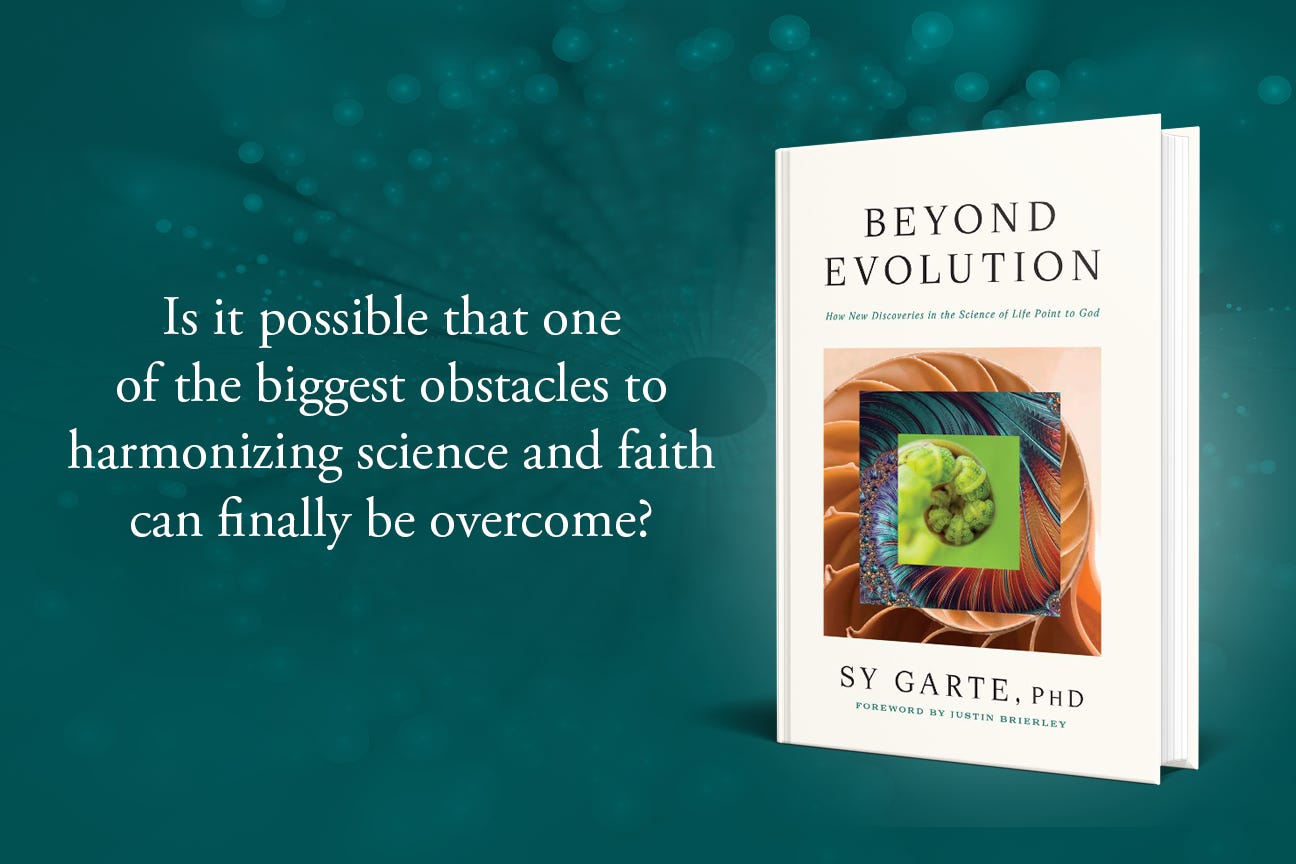
A flash point for much of the science vs. faith divide has been Darwinian evolution. Sharing the same mistaken belief that science contradicts the Bible, many scientists and Christians have concluded that the worlds of science and religion are at odds. But according to biologist Sy Garte, PhD, evolution is irrelevant to the harmony of faith and science. And revolutionary new developments in biology are providing stronger evidence than ever before of a purposeful creator God. In this book, Dr. Garte combines the latest research with a biblical worldview as he explains:
why biology is at the threshold of a major transition, and why new theories beyond evolution are needed to make further progress
why evolution by natural selection isn’t as fundamental to biological science as many people think—and how divisions over evolution are bad for the church
why misunderstandings about both the Bible and science have caused many people to unnecessarily abandon Christianity
how new evidence of purpose, agency, and decision-making at the cellular level points to a creator God
how the origin of life and human consciousness show that a reductionist, purely materialistic view of life is untenable and ignores new advances in science.
In Beyond Evolution, Sy Garte challenges both scientists and people of faith to follow the evidence wherever it leads—and argues powerfully for why that evidence warrants a belief in God.
“Sy shows how biology will most productively advance with a both-and, not an either-or, approach. I highly endorse this book and believe it should be required reading for every biology student and church leader.”
— Hugh Ross, PhD, pastor, astrophysicist, and founder and senior scholar of Reasons to Believe
“Regardless of one’s position on evolutionary theory or the biblical creation narrative, there is much of value to be gleaned from this concise volume. It is a fascinating and insightful contribution to the science and faith conversation.”
— Melissa Cain Travis, PhD, fellow at Discovery Institute’s Center for Science and Culture
Find Beyond Evolution at Amazon, Tyndale, Barnes & Noble, Christianbook.com, and Books-a-Million.
*sponsored
Wow. I just have a simple question at this point. What is your profession. Only out of curiosity. I will at some point have a lot to say in answer to your latest comment/essay, some of which might surprise you. At the moment I am a bit overwhelmed with many unexpected reactions to the book (most of them positive, I might add) but I will post again, once I catch my breath. Peace.
You wrote: <<We have seen that there is no clear reason that life should arise from a sea of chemicals. In fact, not only do we not know the answer to that question, we do know enough about chemistry and physics to be able to say, “There is no reason that life should exist.” We can exclude any scientific reason for the existence of life based on all the science we know. We can see there is no reason for anything to be alive. Where does this leave us?>>
Nonsense. Although there does not appear to have been any polls on support for abiogenesis among academic biologists, it's a very safe bet that the vast majority of these think abiogenesis occurred. 97-98% of academic biologists support evolution by natural selection, and it's unlikely than any more than a tiny handful of these think that a deity needed to assemble the first proto-bacterium before stepping aside and letting natural selection get to work.
Darwin never published his private speculations on abiogenesis, as he had no empirical evidence to support these, but his ideas were nevertheless remarkably prescient From his 1871 letter to his friend Joseph Hooker:
<<It is often said that all the conditions for the first production of a living organism are now present, which could ever have been present.
But if (and oh what a big if) we could conceive in some warm little pond with all sorts of ammonia and phosphoric salts, - light, heat, electricity &c. present, that a protein compound was chemically formed, ready to undergo still more complex changes, at the present day such matter wd be instantly devoured, or absorbed, which would not have been the case before living creatures were formed.>>
Abiogenesis has been an active field of research for over 70 years, having begun with the Miller-Urey experiments in 1953. Hundreds of research papers are published annually on this topic. Obviously, hundreds of competent chemists and biologists disagree with your claim that "there is no clear reason that life should arise from a sea of chemicals."
We have already observed the spontaneous self-assembly of long RNA strands, viruses, and bacterial organelles. It's not so much of a leap to predict we will one day witness the spontaneous self-assembly of a simple living thing from simpler self-assembled components.
I think living things are inevitable under the right conditions. Sterile planets are sterile for a reason, not just unlucky. Intelligent life is likely different and requires too many happy accidents to be widespread. Life is likely commonplace in the universe but intelligent life as rare as orchids.