
Knowing the Trinity
By Stephen E. Parrish
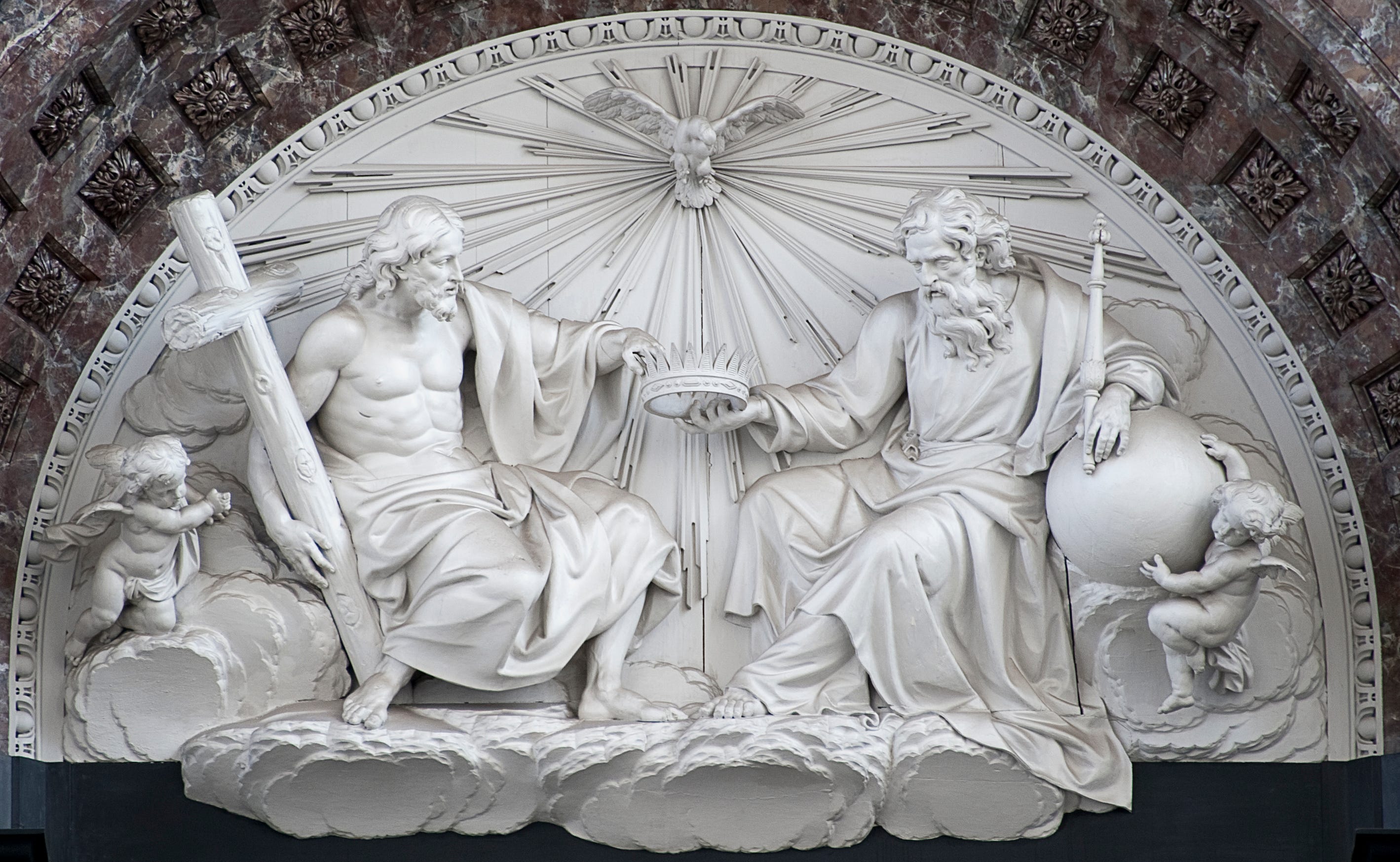
What is the Trinity? Put simply, it is the idea that there are three persons in the one being of God. Linda Zagzebski argues for five distinguishing characteristics of a person. They are: 1) a rational nature; 2) subjectivity; 3) relations with other persons; 4) being free; and 5) incommunicability. The last term needs some explication. She quotes an aphorism of Roman law: “A person is a being which belongs to itself and which does not share its being with another.” This last point is not true of the Trinity, in which I argue that the members all share being with each other.
It is, indeed, difficult to fully understand the Trinity, but as William Hasker wrote, “We have a name for those who make the Trinity easy to understand; we call them heretics.”
Three centers of consciousness
The concept of the Trinity that is being outlined here is that God is conceived of as existing as one being consisting of three different centers of consciousness. (Henceforth, COC will be used for centers of consciousness). There are, therefore, three different persons in God. This is taken to be both eternally and necessarily true. Reality could not exist in any other way than that this God exists. Each member of the Godhead knows the others necessarily, thoroughly, and perfectly, and is necessarily involved with the others. Each of the three persons is completely intermingled with the others and could not exist or act in any way without the others, a doctrine known as perichoresis. As Thomas McCall writes,
I believe that divine revelation reveals that there is exactly one God who exists necessarily and who exists necessarily as triune; the Father, the Son, and the Holy Spirit are three fully divine persons who live in a perichoretic communion of holy love. By “fully divine” I mean that the divine persons are homoousios; each divine person has the complete divine essence and enjoys ontological equality with the other divine persons. By “divine persons” I mean necessarily existent entities who enjoy “I-Thou” relationships within the triune life. By “one God” I intend a wholehearted commitment to monotheism: there is exactly one God, and this one God exists as three persons.
This is not the only concept of the Trinity. Other theologians, who also call themselves Trinitarians, reject the notion of three COCs in one God. The three persons of the Trinity are conceived as being constituted in some other manner. It is claimed that this is the historic belief of the church. The concept of three COCs in the Trinity is sometimes said to have come about by misunderstanding, because in ancient times, what the word person meant is different from what it means today, leading to conceptual confusion.
On the other side of the debate, Matthew Barrett argues, “Separate, individual centers of consciousness and will may be true of created persons but cannot be true of divine persons, otherwise the Godhead would be divided.”
This may be called the classic Trinity versus the social or relational Trinity debate. On the classic side are those who deny three COCs, and, in contrast, those who affirm three COCs in God are sometimes called “social” trinitarians. Of course, one must be careful here, because different philosophers and theologians conceive, for example, of the social Trinity in different ways from others. Their different definitions therefore muddy the picture.
Who is right? Obviously, this is a matter of opinion. However, several points should be made. First, if the three persons of the Trinity are not three COCs, what are they? Here, classic trinitarians do not seem to me to be very clear. Having three different somethings in God’s being needs some explanation if they are not conceived of as being COCs. At present, calling them persons when they are not thought of as COCs is only confusing things. So, what are they?
I remember thinking as a boy as I sort of listened to sermons in church, that the Trinity must be composed of different COCs. I also think that the average churchgoer, to the extent that he or she thinks about the matter, thinks of the Trinity in a COC manner. If classic trinitarians think of the Trinity as something other than COCs, they should give them another name than “person” to stop confusing people and causing false beliefs. However, what would be put in their place is unclear, because if the members of the Trinity are not persons in the modern sense, it is unclear as to what they truly are.
If the classical view of the Trinity is that there are not three COCs in the Trinity, does not this seem to be close to unitarianism? Even if there are three somethings, if there are not three subjectivities, which is part of what is now meant by the concept of person? Is there then only one subjectivity? If so, this seems to be a unitarian notion of God.
Further, Thomas H. McCall and William Hasker both present evidence that some thinkers in earlier centuries did reckon three COCs in God. So it seems that the relational view may also have deep historic roots.
For me, it seems that the only way that a Trinity can be truly conceived of, wherein there are three persons in the Godhead, is that of three COCs. To hold otherwise seems to deny what is fundamentally meant by the concept of being a person. No doubt, divine persons are in many ways different than human or other finite persons; but it seems that a basic element of the concept of “being a person” is that of being a center of subjective states, and for the Trinity to exist on this model, it seems there must be three distinct COCs in God’s very being. However, there is some ambiguity in the notion of the term distinct. Distinct can mean apart, but it can also simply mean “different.” This latter meaning is applicable here. I understand the persons of the Trinity to be totally united with each other. They are completely open to each other, having the same thoughts, and necessarily so. They have only one will and are completely equal to each other. There are, in different senses, three COCs and one COC, as they are completely united in all respects. It is true that there may be difficulty in understanding what the early theologians who formulated the creeds exactly meant by the word person. They may not have understood the terms in precisely the same way that we do today. Specifically, they may not have understood the term person as being something that inherently and necessarily contains the concept of a center of consciousness, a center of subjective states.
However, today the average person would think of persons like this as the center of a consciousness that contains such subjective states. Indeed, outside of theologians and philosophers, I believe that the average person will imagine a person in such a manner—it is a natural way to look at things.
Indeed, the average Christian would likely be quite surprised and upset to think that what he or she thought was a person was really something else entirely. That is, upon hearing that the members of the Trinity were not persons in the sense that they were not subjects of conscious states, the average Christian would think that this is not what they had thought of the Trinity as being. In effect, they would think that what they were hearing was really unitarianism, and not the traditional doctrine of the Trinity at all.
I am not saying that philosophers and theologians should entirely guide themselves in their thinking about God by what the average person in the pew thinks. Often what they think is uninformed and uncritical. Nonetheless, to move away from what the local churches and almost all their most informed members have taught for centuries is a dubious move at best. The nature of God is no trivial issue. When Christians pray to not only God but specifically to one of the members of the Trinity, they expect, indeed, take for granted, that it is a person to whom they are praying. It would do no good to pray to something else; only a person can understand a prayer and potentially act upon it.
— Dr. Stephen E. Parrish is Emeritus Professor of Philosophy at Concordia University in Ann Arbor Michigan, where he taught for 23 years. He received his Ph.D. from Wayne State University in Detroit. He is author of God and Necessity, The Knower and the Known, Atheism? A Critical Analysis, and Why Are There “OUGHTS”?: The Nature of Moral Necessity. He has three grown daughters, and lives with his wife, Elenn’, and cat.
---
Excerpted from Why Are There “OUGHTS”?: The Nature of Moral Necessity by Stephen E. Parrish (Wipf and Stock, 2026). Used by permission.
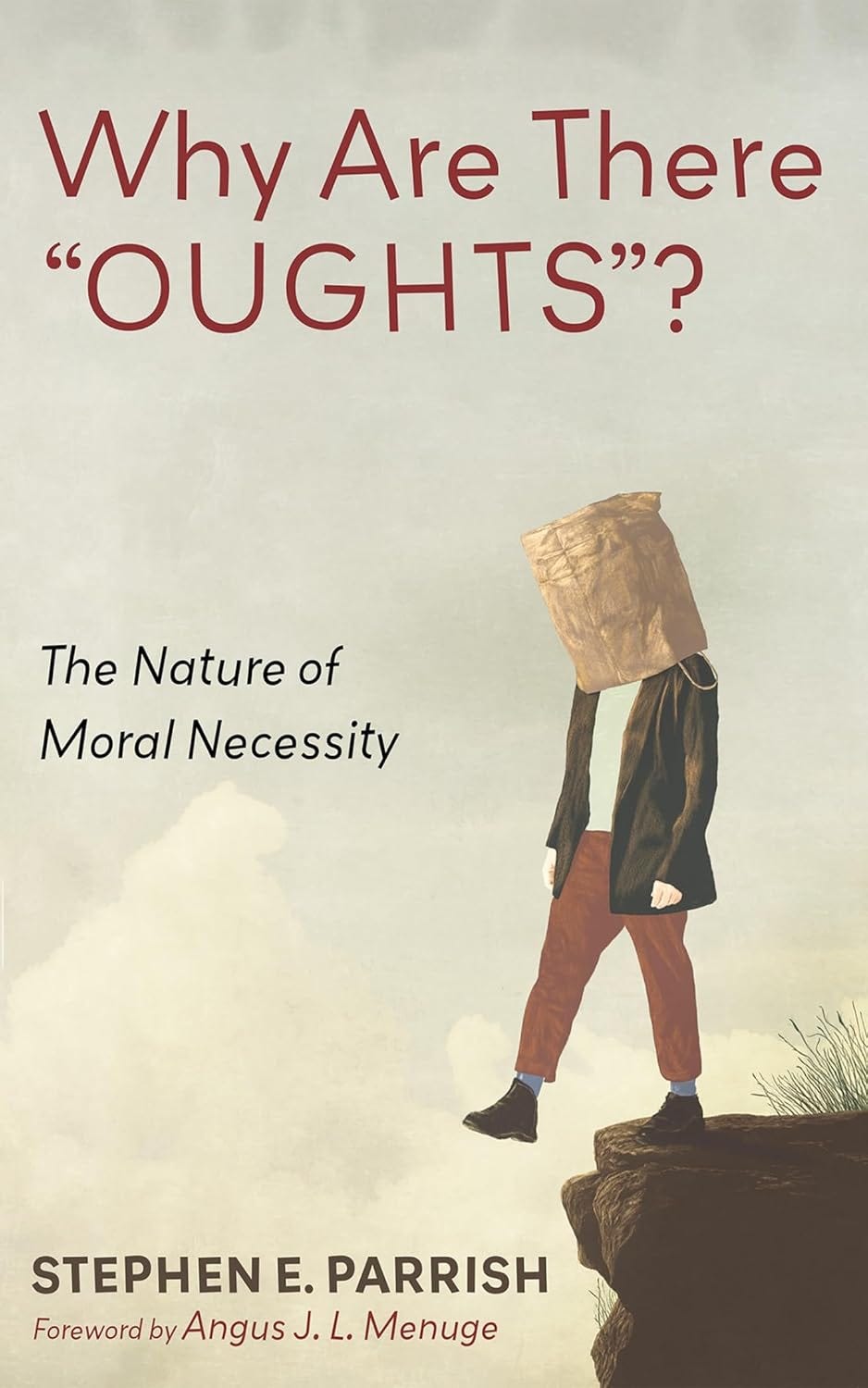
Many would agree that we live in a world of decaying morality, in an age with much disagreement about fundamental moral issues. Debates surge over matters such as abortion, euthanasia, sexual issues, the proper role of government, and so on. The disputes are never ending. Agreement is difficult because there is no common ground on the very nature and existence of morality. Why are there OUGHTS? Who says what is right or wrong? Is there an ultimate measure for ethics? How can we know?
Are there in fact moral laws that are binding on us, or are they merely constructed on the values and desires of humans? And if there are moral laws external to us, why is this true? Examining the fundamental roots of morality, this book argues that moral laws do, in fact, exist, and necessarily so. Parrish takes the readers on an extensive journey through the realm of ethical theories, and finally delivers them to the very foundation—the source—of moral laws, the why of the oughts.
“Steve Parrish’s work has been a tremendous inspiration to me, and this book is certainly no exception. In an eminently accessible way, Parrish brings his prodigious gifts to bear and offers a treasure trove of rich insights about the history of ethics and the metaethical terrain, delivering needed clarity and depth of analysis. Attentive readers will benefit immensely from these explorations.”
—David Baggett, co-author of Reasonable Moral Faith
“[Parrish] offers a meticulous, wide-ranging evaluation of competing metaethical options before concluding that trinitarian theism is the strongest ground for moral necessity. This book greatly clarifies the nature of moral obligations and strongly supports the moral argument for God’s existence.”
—Angus J. L. Menuge, Professor of Philosophy, Concordia University of Wisconsin
Find Why Are There “OUGHTS”? at Amazon (ebook / print), Wipf and Stock, Barnes & Noble, and Books-A-Million.
*sponsored
I've been thinking about this more in the past few days. I recently taught the philosophy of personalism in one of my classes. One element of this philosophy is the idea that persons, whether human or divine, are essentially relational. This makes a lot of sense, and helps ground belief in the Trinity, perhaps not exclusively, but still, it is worth reflecting on.
This is a great piece on the Trinity. A quick overview of the doctrine that summarizes some of the details regarding the nature of God. Thank you Dr. Parrish.