
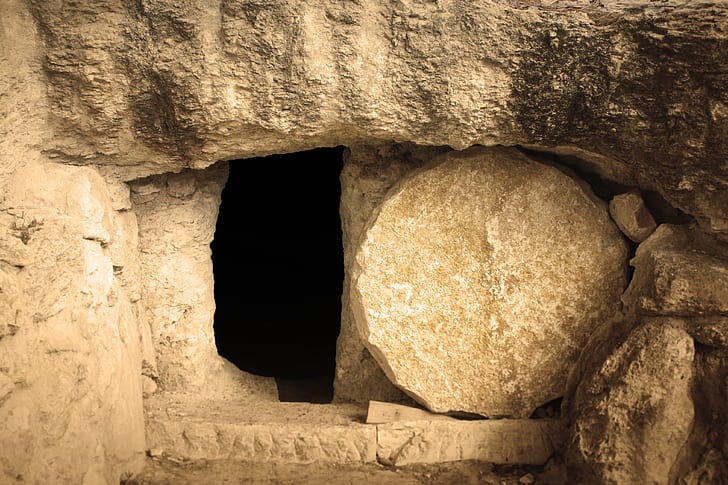
In the canonical gospels, as virtually all scholars concur, the resurrection of Christ, and the hope of resurrection for followers of Christ, is a concrete and physical reality involving the body of flesh and bones. In Luke’s Gospel, for example, the resurrection narrative begins with the disciples’ discovery that Jesus was no longer in the tomb (24:1–12; cf. 24:23–24). At the climax of the narrative, Jesus shows himself alive to the Twelve and the other disciples, inviting them to “touch me and see, because a spirit does not have flesh and bones as you see that I have” (Luke 24:39). In John’s Gospel, Jesus invites doubting Thomas to probe the scars in his hands and side (John 20:24–29). The speeches of the apostles in Acts similarly stress that the flesh of Jesus was raised without undergoing decay (2:25–31; 13:34–37), and that the risen Jesus ate and drank with his disciples (10:40–42; cf. 1:3–4). In the gospels and Acts, Jesus’s bodily resurrection from the tomb fulfills the creator God’s promised conquest of death, bringing the hope of bodily resurrection for all who believe (John 5:24–29; 6:39–40, 44, 54; Acts 4:1–2; 23:7–10; 24:14–15; 26:6–8; 26:22–23).
In the scriptural interpretation of the ancient church from the first century onward, the resurrection hope expounded in 1 Cor 15 was understood, in congruity with the gospels and Acts, in terms of a resurrection of the flesh, identifying the resurrected body of this passage with the earthly, fleshly body raised to life and transformed to be imperishable. To be sure, “Gnostic” interpreters such as the Valentinians and Ophites, who believed that the material world and the physical body were inherently evil, read this chapter in ways that excluded a literal resurrection of the body (Gos. Phil. 56.26–57.22; Irenaeus, Haer. 1.30.13). And the Alexandrian exegete Origen, influenced by Gnostic thought, apparently interpreted 1 Cor 15 as involving a resurrection of a heavenly or spiritual body composed of ethereal matter, distinct from the earthly body of flesh (Sel. Ps. 11.384 [on Ps 1:5]; Comm. Matt. 17.29–30; Princ. 2.10–11; Cels. 5.18–23). However, Gnostic readings of this chapter were rejected within the ancient church, and Origen’s teaching on the resurrection was condemned as heretical by the Fifth Ecumenical Council (Constantinople II). Patristic interpretation, from Clement of Rome in the first century to Augustine in the fifth, unanimously interpreted 1 Cor 15, in agreement with the canonical gospels, in terms of a physical resurrection of the body of flesh and bones. This reading was in agreement with the generally received ancient Christian doctrine of resurrection as the reconstitution and glorious transformation of the present mortal body, a transformation involving “enhancement of what is, not metamorphosis into what is not.” M. E. Dahl described this orthodox conception as involving the claim that “the resurrection body is this body restored and improved in a miraculous manner.” The church’s historic creeds gave expression to this hope in the most striking way by affirming “the resurrection of the flesh.” Throughout almost two millennia, exegesis of 1 Corinthians 15 was carried out in the context of this conviction—shared alike by Catholic, Orthodox, and Protestant interpreters—that the resurrection hope of the faithful that Paul expounds in this chapter is a resurrection of the flesh.
However, an important shift took place around the turn of the previous century. In an influential monograph published in 1896, Ernst Teichmann argued, in a reading with clear affinities to that of Origen, that Paul in this chapter envisions a “spiritual” resurrection body, that is, a body no longer made up of flesh but composed of spirit or πνεῦμα, the same fine pneumatic “stuff” of which the heavenly bodies are composed. In striking contrast to the historic, ecclesial interpretation, in Teichmann’s view Paul in 1 Corinthians 15 explicitly opposes a resurrection of the flesh. Teichmann’s approach found many imitators, so that by the midpoint of the previous century M. E. Dahl could describe a reading along these lines as “the accepted exegesis” of the chapter. That was perhaps an overstatement even at the time, and in recent decades a number of studies have appeared by such scholars as N. T. Wright, Richard Hays, and Martin Hengel opposing this revisionist reading and interpreting 1 Cor 15, in continuity with the four gospels and the church’s historic teaching, in terms of the resurrection of the flesh and its glorious transformation to imperishability. However, an interpretation of this chapter largely along the lines suggested by Teichmann has in recent years found significant scholarly support. Prominent advocates of this rival interpretation include Dale Martin, Troels Engberg-Pedersen, and Jeffrey R. Asher, but a number of other interpreters maintain this position as well. Despite differences in detail, these scholars all argue that Paul in 1 Cor 15 envisions an ethereal or “spiritual” resurrection body: a body composed of spirit that excludes participation of the earthly body of flesh and bones in the life of the world to come.
This latter reading of 1 Cor 15 is the basis for a view of Christian origins in which belief in the resurrection of Jesus’s crucified body from the tomb, such as we see reflected in the narratives of the four gospels, was a later development, unknown to Paul and the earliest Christ followers. As Rudolf Bultmann famously remarked, “The [gospels’] accounts of an empty tomb are legends, of which Paul as yet knew nothing.” These scholars claim to find in the primitive apostolic confession of 1 Cor 15:3–8 an understanding of Jesus’s “resurrection” as his translation to heaven in a postmortem disincarnate form discontinuous with his crucified body. In this view, belief in the resurrection of Jesus’s crucified body from the tomb was neither primitive nor apostolic but a later conception in discontinuity with the earliest kerygma.
This once novel interpretation of 1 Cor 15 is today widespread and pervasive not only in specialized studies of that chapter or the resurrection in general but also in the wider scholarly literature touching upon Paul’s teaching on the resurrection or on 1 Cor 15. In the scholarly literature it is routinely assumed that Paul’s teaching in this chapter is incompatible with the doctrine of the resurrection of the flesh that we find in the four gospels and in the church’s historic teaching. Close exegesis and argument are commonly considered unnecessary. It is normally considered sufficient to cite (in English translation) Paul’s description of the resurrected body as a “spiritual body” in 1 Cor 15:44, or his reference to Christ as a “life-giving Spirit” in 15:45, or (above all) Paul’s statement in 15:50 that “flesh and blood cannot inherit the kingdom of God.” The latter verse is a widely used “prooftext” that Paul, contrary to the canonical gospels, did not affirm that Jesus rose in the flesh and did not believe in a coming resurrection of the flesh. Thus Dale Martin asserts: “Paul himself believes that the resurrected body will not be composed of flesh (see v. 50).” Paula Fredriksen writes that Christ arose “in a spiritual body, Paul insists, and definitely not in a body of flesh and blood (1 Cor 15:44, 50).” Dag Øistein Endsjø speaks of “the fleshless resurrection body of Paul.” And Ernst Käsemann can confidently assert: “The idea of … the resurrection of the flesh … is un-Pauline.”
The implications of this interpretation of 1 Cor 15 are massive, going to the heart of the Christian faith. If this reading of 1 Cor 15 is valid, the church’s historic doctrine of the resurrection, expressed in her creeds and worship, is a late and inauthentic imposition contrary to the faith of the apostles and the first Christians. Moreover, in this reading the accounts in our canonical gospels of Jesus’s bodily resurrection from the tomb do not reflect the message of the earliest eyewitnesses but later legends. In this interpretation of the chapter, the good news of the resurrection proclaimed in 1 Cor 15 and the good news narrated by Matthew, Mark, Luke, and John are different gospels indeed. For (in this reading) they are fundamentally at variance regarding the meaning of the affirmation that Jesus has been raised from the dead on the third day and the nature of the hope that Jesus’s resurrection offers those who believe.
[This] this widespread interpretation is founded upon a mistaken exegesis. The resurrection Paul defends and expounds in 1 Cor 15, in continuity with the four gospels and historic Christian teaching, is the resurrection of the flesh. Moreover, [the] apostolic formula in 1 Cor 15:3–8 presupposes a narrative of the kind we see in the canonical gospels, involving an empty tomb as well as eyewitness encounters with a Jesus risen in the same body in which he was crucified. In Paul’s resurrection chapter we find a robust doctrine of bodily resurrection. The resurrection Paul proclaims in 1 Cor 15 is not the mere transferal to an ethereal or spiritual state supposed by Teichmann and his modern heirs, offering yet one more expectation of spiritual afterlife among many in the ancient world. The resurrection Paul proclaims in this chapter is the conquest of bodily death. It is the final triumph of God.
— James P. Ware is a scholar of New Testament and ancient Christianity and professor emeritus of religion at the University of Evansville. His books include Synopsis of the Pauline Letters in Greek and English, Paul’s Theology in Context: Creation, Incarnation, Covenant, and Kingdom, and The Final Triumph of God: Jesus, the Eyewitnesses, and the Resurrection of the Body in 1 Corinthians 15.
---
Excerpted from The Final Triumph of God: Jesus, the Eyewitnesses, and the Resurrection of the Body in 1 Corinthians 15 by James P. Ware (Eerdmans, 2025). Used by permission.
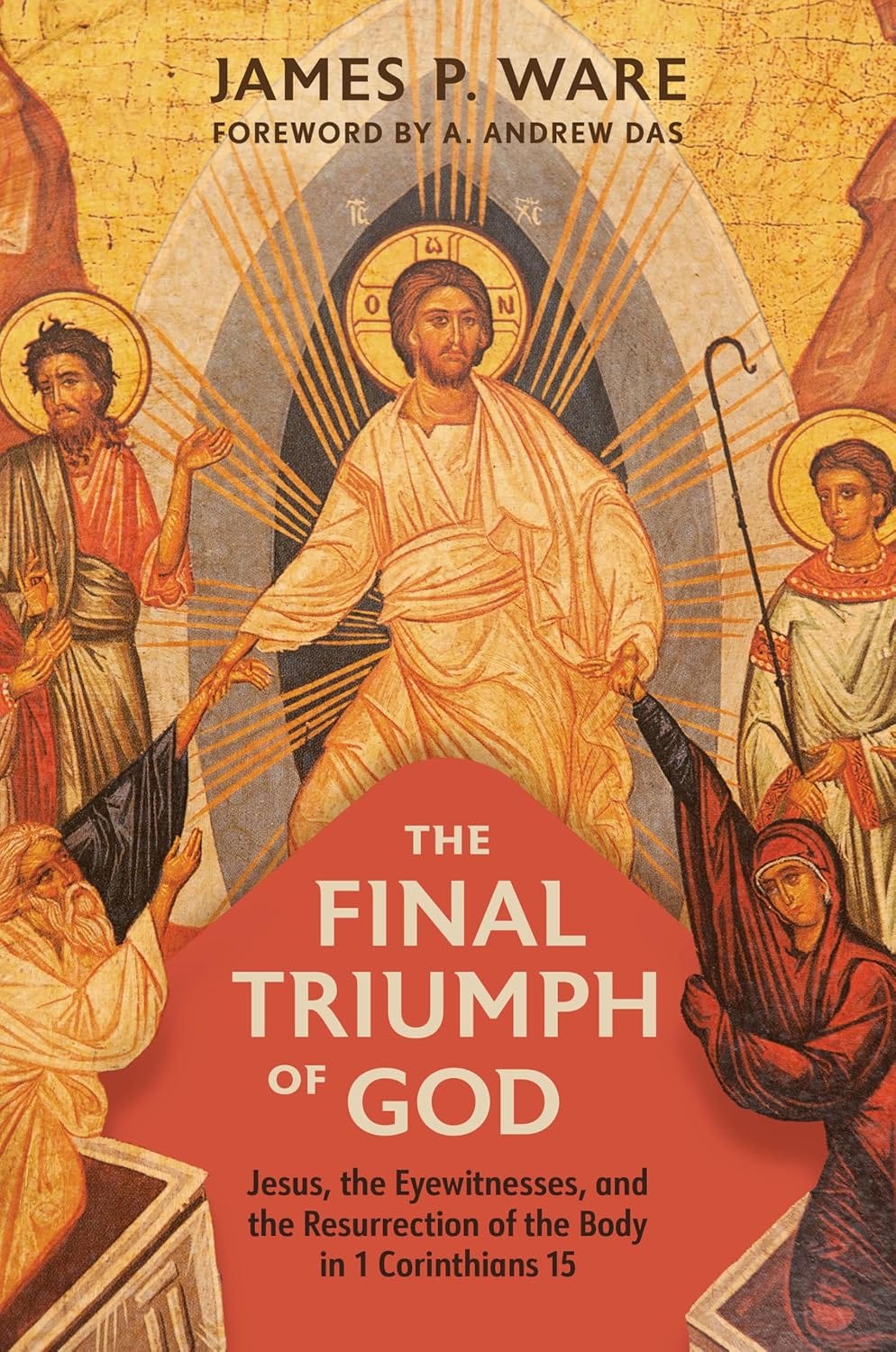
Making a compelling case based on new evidence and fresh exposition, James Ware affirms the church’s historic reading of 1 Corinthians 15. He shows that the apostolic formula in 1 Corinthians 15:1–11 proclaims, in continuity with the Gospels, the resurrection of Jesus’s crucified body from the tomb, and that the hope of the resurrection described in 1 Corinthians 15:12–58 involves the miraculous revivification of our present bodies of flesh and bones and their transformation to imperishability.
Ware’s monumental study is unmatched for its comprehensive examination of the historical setting, literary structure, syntax, and vocabulary of 1 Corinthians 15. This in-depth verse-by-verse commentary provides new insights into the text, original solutions to hitherto seemingly irresolvable difficulties, and a convincing reading of the chapter unfolding its rich theology of the resurrection as the consummation of union with Christ.
“James Ware’s exposition of 1 Corinthians 15 is a masterpiece of careful exegesis combined with theological insight. On the one hand, Ware defends a traditional and historically rooted conception of the resurrection. On the other hand, there are numerous fresh exegetical insights that characterize his exposition. No other study on 1 Corinthians 15 surpasses Ware’s work.”
— Thomas R. Schreiner, Southern Baptist Theological Seminary
“Fully conversant with the Greco-Roman context, interpretations of 1 Corinthians 15 in the early church, and current secondary literature, this book is the most thorough and up-to-date commentary on 1 Corinthians 15 available. Ware’s careful exegesis, accented by sharp theological insight, breaks new ground in solving some of the chapter’s conundrums. The book provides readers a rich understanding of Paul’s resurrection theology, and I can’t recommend it enough!”
— Andy Johnson, Nazarene Theological Seminary
Find The Final Triumph of God at Eerdmans, Amazon, Barnes & Noble, Christianbook.com, Walmart, and Books-a-Million.
*sponsored
Thank you. It was 1 Corinthians 15 that was the final nail in the coffin that was my atheism. An ethereal, non-bodily, spirit-only 'resurrection' would never have convinced me that Christianity is true. Paul's preaching of the Gospel always included Christ's bodily resurrection from the dead and our physical resurrection - "the redemption of our body." (Romans 8:23). I appreciate your careful analysis of this important 'doctrine' that many people today misunderstand to their own detriment and that of the 'church.'