
When Is War Justified?
By Daniel Darling

When should a nation engage in conflict and go to war? This is a question that faithful Christians have considered throughout church history. Some, particularly in the Anabaptist or Quaker traditions, adopted pacifism. Stanley Hauerwas, in his book The Peaceable Kingdom, writes, “Nonviolence is not one strategy among others. It is not even a strategy. It is simply what we are called to be as followers of Jesus.” John Howard Yoder says similarly, “The wielding of the sword is always an expression of a degree of unbelief, and the church that blesses this undertaking is always marked by a measure of apostasy.” The pacifist tradition, while a minority, is a respected view.
However, most Christians have accepted some level of use of force by governments, particularly considering the mandate given to the state in passages like Romans 13. Most often, Christians, working through Scripture, have typically applied what is called “just war theory” in evaluating conflicts. Originally formulated by Augustine of Hippo, it has been adjusted and reviewed by every generation as the nature of war changes.
Just war theory has two components. The first is jus ad bellum, which is Latin for “right to war.” These are the criteria a nation must consider before engaging in conflict. The second is jus in bello, which is Latin for “just warriors in battle.” These are the criteria for a nation engaging in a just war. This also guides a nation’s conduct in conflict.
To evaluate whether to engage in war, nations must consider five factors.
A nation must have legitimate authority. Romans 13, as we saw above, gives human governments the right and duty to protect its citizens against evil. Thomas Aquinas made this argument:
[I]t is not the business of a private individual to declare war, because he can seek for redress of his rights from the tribunal of his superior. . . . And just as it is lawful for them to have recourse to the sword in defending that common weal against internal disturbances, when they punish evil-doers, . . . so too, it is their business to have recourse to the sword of war in defending the common weal against external enemies.
Individuals don’t go to war. Nations do. But simply because a nation has the God-given authority to bear the sword doesn’t mean that it is always justified to engage in conflict. This power is not unlimited. The possession of large armies and sophisticated weaponry isn’t a justification for war. There must be a higher moral and legal reasoning.
A nation must have a just cause. Romans 13 says that governments are “God’s servant for your good” and bear the sword to “bring wrath on the one who does wrong.” Fighting, for instance, was a good cause for America and her allies in World War II to seek to defeat the Third Reich, who wished to establish a “superior Aryan race” and systematically massacred millions of Jewish people and threatened the peace of freedom-loving nations. The cause should align with rewarding good and punishing evil.
A nation must have right intent. It’s not enough to have a just cause. The intent should also be right. Governments should only wage war if the intent is both to bring justice to evildoers who prey on innocents and to establish a lasting peace. Motivations such as conquering territory or ethnic hatred are illegitimate. Part of the intent should be getting the opposing nation to stand down from its actions and agree to peace terms. We must ask questions like, What is the endgame of this conflict? Sometimes, initial engagement can lead to a peace by quickly demonstrating force against a bad actor.
War should also be the last resort, which is a key component of just war theory. Have other reasonable options, including diplomacy, economic measures, and other actions been considered? This is often a difficult calculus as terrorist networks, rogue nations, and other bad actors will often “run out the clock” in fruitless diplomatic negotiations. Still, even if conflict is unavoidable, nations shouldn’t be eager for war. War may sometimes be necessary to address wrongdoing, but it should never be undertaken lightly or without careful consideration.
A nation must have proportional objectives. What this requires of war planners is to at least try to estimate if the cost of war—with blood and treasure—is worth the possible bad outcomes. Ethicist Ken Magnuson explains it this way: “If the cost of war is greater than the existing injustice, it weighs against going to war. That is, the cure must not be worse than the disease.” The existence of bad actors doesn’t always necessitate full-scale war because the outcome might result in an even less peaceful world.
A nation must have reasonable chance of success. It is prudent and wise for nations to consider whether the conflict can be won. Jesus referenced this wisdom-seeking in Luke 14: “Or what king, going to war against another king, will not first sit down and decide if he is able with ten thousand to oppose the one who comes against him with twenty thousand? If not, while the other is still far off, he sends a delegation and asks for terms of peace” (vv. 31–32).
This criterion, as with considering proportional objectives, is difficult to measure and obviously should be weighed with the other mentioned moral categories. For instance, sometimes in a defensive war, a nation has no other alternative than to fight for survival. In 2022, Russia attacked Ukraine, a sovereign nation. Ukraine, the smaller nation, was not predicted to be able to withstand the assault and yet has fought back admirably. And at the time of writing this, there are peace negotiations but not a conclusion to the war. In principle, unless a nation is defending their homeland like Ukraine, a nation should not seek conflict in which there is not a clear path to victory.
Just war principles don’t merely guide nations in making decisions about going to war but also about the conduct of nations in war. Simply because a conflict is just doesn’t give the nation fighting that war a blank check to employ any means necessary.
Three principles apply here with the jus an bello (just warriors) aspect of just war. First, nations should employ discrimination between soldiers and civilians, between noncombatants and combatants. As much as possible, governments shouldn’t target civilians or civilian populations. It is impossible to engage in war and not see significant civilian casualties, but governments should do everything possible to avoid them and refrain from deliberately targeting civilians. In modern warfare, this has become increasingly difficult, especially with urban warfare where the enemy often hides among civilian populations on purpose or, in the case of Hamas, stores military and weaponry in civilian locations and uses their own civilians as human shields.
Even though the enemy mixing combatants and noncombatants bears responsibility for civilian casualties and itself violates the principles of just war, the attacking army should do everything possible, including warning civilians of an impending action, to avoid civilian death. This principle of discrimination also rules out terrorism or guerrilla warfare against civilian populations as a violation of just war.
Governments engaging in a just war also should not use evil means. For instance, the use of torture, rape, genocide, and other means violates just war and human dignity. What’s more, governments should treat prisoners with respect and care. This also involves thinking seriously about the types of weapons used, like chemical and biological warfare.
Lastly, governments in war must engage in proportionality. Just war scholar Paul Miller defines it this way: “In war, soldiers must use means—tactics and weapons—that are proportionate to the end they are trying to accomplish. What does proportionality mean? It means that it is not morally just to use a nuclear weapon to take out a sniper. A military cannot bulldoze an entire village to find one insurgent. It means that nations must calibrate weapons, tactics, and targets to the military requirements of the mission, and no more. Broadly, it is not morally just for nations to use excessively brutal, dehumanizing, or vindictive means to achieve our end.”
All these principles make up the criteria for determining if a war is just. It’s difficult to discern what a nation should do. And when confronted with threats in real time, presidents and prime ministers must make difficult decisions.
— Daniel Darling is an author, pastor, and thought leader. He currently serves as the Director of The Land Center for Cultural Engagement at Southwestern Baptist Theological Seminary and Assistant Professor of Faith and Culture at Texas Baptist College. He is a columnist for World, a contributor to USA Today, and has pastored churches in Illinois and Tennessee.
Image by luxstorm from Pixabay
---
Excerpted from Biblical Wisdom for Everyday Life: Ethical Answers to Cultural Questions by Daniel Darling (B&H, 2026). Used by permission.
In an age of rapid social change and moral confusion, this book equips Christians to approach tough ethical questions with both conviction and compassion. Whether you’re wrestling with how to think about cohabitation, abortion, marijuana, IVF, end of life issues, or the rise of psychedelic drug use, this book draws on the timeless truths of God’s Word to offer clarity, not clichés.
Biblical Wisdom for Everyday Life: Ethical Answers to Cultural Questions offers a faithful and practical guide for navigating some of life’s most pressing moral and cultural dilemmas. Rooted in Scripture and shaped by the Christian tradition, this book is designed to help believers think clearly and live wisely in a complex world.
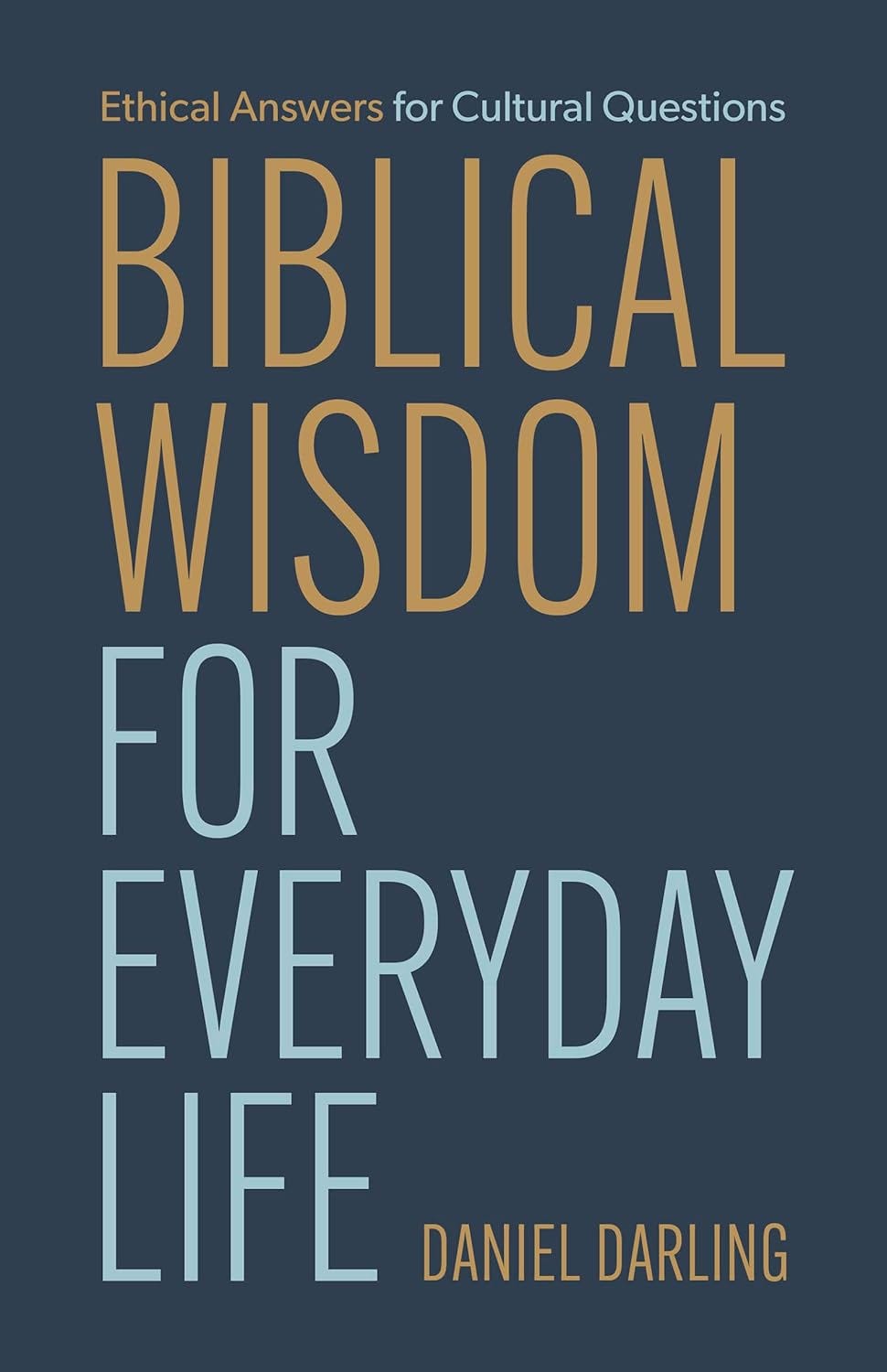
Find Biblical Wisdom for Everyday Life at Amazon, Barnes & Noble, Christianbook.com, Books-A-Million, and Walmart.
*sponsored
There is a "Christian" sect in SW Idaho/Eastern Idaho. They determine what medical care their children can get using Biblical guidance. Their children die much more frequently than other children their age. A teacher of one of those children couldn't stand what was happening to one of her students. She took the child to a doctor. The child had a strep infection and she got antibiotics for the child. The child lived but the teacher lost her job. How can you possibly believe that scripture is an adequate guide for everything. Human knowledge has increased greatly since the last part of the Bible was written. Maybe God made humans with intelligence so that humans could learn. There are many parts of scripture that I believe can be helpful guiding choices and can tell humans important things about the ways humans should treat each other. I also think humans have curiosity and have discovered ways to solve problems. It has been very slow and there are advances and then losses. A way to prevent polio was not discovered by looking to scripture. You could think about human problem solving ability as a gift from God.
Moral principals and intelligence are not in the same category. Like trying to determine wind speed with a coffee table. We had those few centuries of Christian thought to continue thinking that sin causes smallpox. There are ways to have this discussion (I think) without mixing "Just War" theory with religion (although religion has been purportedly the basis of many wars). It is possible that the human species hasn't evolved far enough to escape fear of "the other" or wishing to have access to the resources of others. It is possible that humans are not uniformly able to see other cultures as an opportunity for increased cultural complexity rather than a threat.