

In forgetfulness, facts elude us, not because we don’t know them, but because we once knew them, and we cannot call them to mind now. Forgetting is not sheer ignorance (what you never knew) but lost knowledge somehow buried from memory. Forgetfulness can be maddening, embarrassing, and even dangerous. This becomes a particular malady when it affects the most significant thing of all—who we are in the universe. Consider what G. K. Chesterton wrote:
Every man has forgotten who he is. One may understand the cosmos, but never the ego; the self is more distant than any star. Thou shalt love the Lord thy God; but thou shalt not know thyself. We are all under the same mental calamity; we have all forgotten our names. We have all forgotten what we really are.
Those who have forgotten their own identities are often the most clamorous in insisting that we know who they are. The LGBTQ movement demands that everyone, including Christians who affirm a biblical sexual ethic, embrace and celebrate ideas that are contrary to Scripture. [T]he key idea is that people are who they express themselves to be, whatever that is. They have no given identity by God. Atheists insist that humans are nothing more than evolved animals whose ancestry is traced to a primordial slime that gave birth without thought to all the living through an unguided and ultimately meaningless process. Pantheists tell us that our secret identity is divine, that we are one with a universal Oneness, if only we could discover it through an altered state of consciousness. Muslims insist we are slaves to Allah and must submit to his commands in the off chance that our submission will be rewarded with paradise. But truth must be wrested back from these false views of the self, and that truth is found in the Christian view[.]
The Self as Given by God
We need the truth about who we actually are—not merely a sense of self or a constructed self, or a psychologized self, but the knowledge of who we are objectively in the natural, social, and spiritual world. Chesterton continues the quote above by taking it deeper. We have all forgotten what we really are.
All that we call common sense and rationality and practicality and positivism only means that for certain dead levels of our life we forget that we have forgotten. All that we call spirit and art and ecstasy only means that for one awful instant we remember that we forget.
We “forget that we have forgotten” who we are when we cease to care about the truth of who we are, of our being, of our identity. When we forget someone’s name, it is obvious that we have forgotten something—if we care to remember that name. But if we don’t care about another’s name, if we don’t care about our own true name, we will evade the issue, distract ourselves, and rather attend to commonplaces, untroubled by philosophical questions.
In The Screwtape Letters, C. S. Lewis explains this as a strategy the demons use when someone starts to think seriously about God and themselves. Yet the unfamiliar, the biblical account of who we are, is what ultimately explains our familiar experiences of ourselves and of others. But sensory stupefactions stultify such investigations. As Blaise Pascal wrote, “We run heedlessly into the abyss after putting something in front of us to stop us seeing it.” But as Chesterton reminded us, spirit, art, and ecstasy can remind us that there is more to life than common experience. So can a spirited argument, which is what we will offer.
We need to know not simply what we are physically (anatomy and physiology), but why we exist as bodies and souls. We will begin by explaining and defending the Christian view of self. That means we are created in God’s image; we are radically fallen; but we are redeemable through the work of Jesus Christ.
We do not give ourselves to ourselves. My self is, in the most basic sense, beyond myself to determine, since I have a nature or essence that I did not and cannot create. This truth radically opposed the claim by atheist philosopher, Jean-Paul Sartre (1905–1980), that “existence precedes essence,” the foundation of atheistic existentialism. He realized that if we have a human nature, something shared by all humans, then that would be traceable to God as Creator. But he reasoned that if there is no God, then there is no human nature, since there is no God to give it. Rather than anchoring a godless humanity in something instinctive or biological (as do many atheists), he opted for sheer will and self-creation. He writes:
What do we mean here by “existence precedes essence”? We mean that man first exists: he materializes in the world, encounters himself, and only afterward defines himself.
While existentialism is not the philosophical powerhouse it was in the 1960s and ’70s, interest in Sartre has been recently rekindled, and his principle is assumed by many, even if they have not heard of the French atheist. He goes on:
Thus, there is no human nature since there is no God to conceive of it. Man is not only that which he conceives himself to be, but that which he wills himself to be, and since he conceives of himself only after he exists, just as he wills himself to be after being thrown into existence, man is nothing other than what he makes of himself. This is the first principle of existentialism.
Even before contrasting this bleak view with the Bible, it should be seen as absurd for at least three reasons. First, human beings unquestionably have a biological essence that they share with all their kin. Although we are not determined by this, to abstract one’s essence entirely from the physical world is a denial of a hard reality. Second, when we look across human history, we find common themes: the quest for meaning, the fear of death, the need for love, the belief in certain moral values, and more. To say that this does not emanate from a given essence or nature is unfounded. Third, and most significantly, the idea that an essence can be created is a contradiction. Whatever exists has an essence; otherwise, it would not exist as it is. (Philosophers call this quiddity.) If something has an essence, it must possess certain essential qualities or properties that define what it is. The claim that “existence precedes essence” is like saying that something can come from nothing, which is impossible. Hence the Latin phrase, ex nihil, nihil fit (from nothing, nothing comes).
The truth is that each person was brought into the world as a particular person with a particular human nature. The existence and design of the cosmos, as well as our awareness of the moral law, speaks to the existence of God, and the Scriptures speak into that condition, telling us who we are. Thus we must take this truth back from existentialism, which gives us a bogus view of ourselves.
As the psalmist wrote, “Know that the Lord is God. It is he who made us, and we are his” (Ps. 100:3).
— Douglas Groothuis is University Research Professor of Apologetics and Christian Worldview at Cornerstone University and is the author of numerous books, including Beyond the Wager: The Christian Brilliance of Blaise Pascal and Christian Apologetics, 2nd ed.
---
Excerpted from Taking Back Truth: A Biblical Response to Common Cultural Lies by Douglas Groothuis (Baker Books, 2026). Used by permission.
With a strong desire to help readers discern truth from error, senior apologist Douglas Groothuis explores our culture’s deficient view of truth and clearly explains the nature of truth, how to know if something is true, and how to bring truth to bear on some of the most pressing issues of our times.
Pointing us back to a biblical worldview as the foundation of our understanding of truth, this honest examination of common cultural lies will equip you to
● identify and resist ideologies based on personal opinion and false premises
● clearly discuss hot-button topics such as race, gender, abortion and human value, morality, and more
● help your friends, family, and others in your sphere of influence recover truth in a relativistic society
Christians must restore truth when it is being undermined. Pick up this book to learn how to defend a Christian perspective and take back truth.
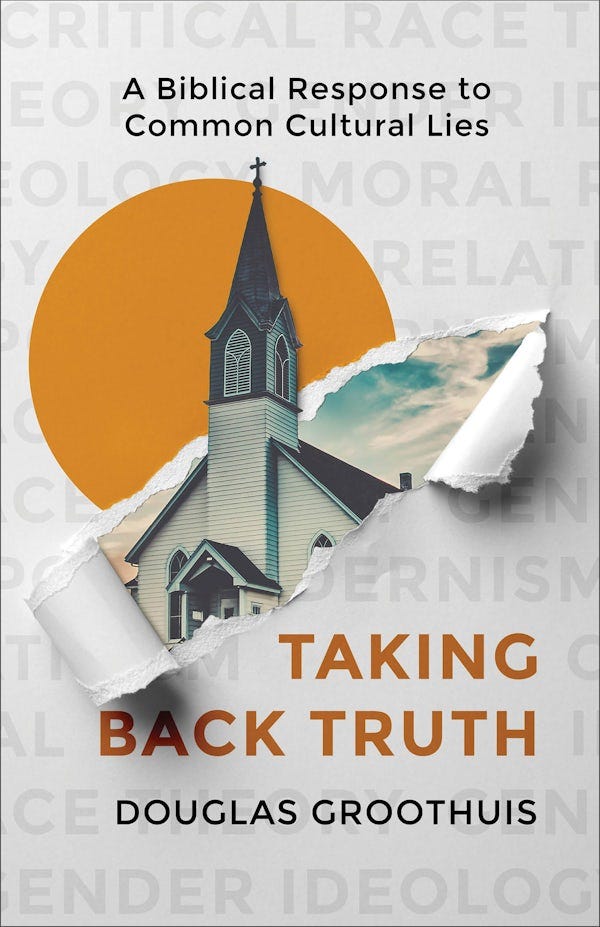
Find Taking Back Truth: A Biblical Response to Common Cultural Lies at Baker, Amazon, Barnes & Noble, Christianbook.com, Books-A-Million, and Walmart.
*sponsored