
Scripture, Creation, and Accommodation
By Michael Horton
The trope of the two books, scripture and nature, goes all the way back to patristic sources. However, as Kenneth J. Howell explains in detail, it became particularly important in Protestant Northern Europe as a way of distinguishing general and special revelation without setting them in opposition. Reference to the “two books” appears in the second article of the Belgic Confession (1561). Based on the book of Romans, Lutheran and Reformed confessions from this period teach that the “light of nature” reveals God’s existence, love, power, wisdom, and moral will (law) but does not reveal the mysteries of the faith, such as the Trinity or God’s saving will in Christ (gospel).
Experimental philosophers during this time still held the classical Greek and ancient Christian view that God is higher than his works and that theology is the highest science. In fact, no group believed that natural philosophy led to the contemplation of God more than seventeenth-century experimentalists. Most of these early scientists wrote on theological and devotional topics. Yet scriptural references are rare in their natural studies, even in those of theologians like Melanchthon, since they were careful to acknowledge the different object and methods of each discipline. Creation reveals God’s invisible attributes and the moral law, but only scripture reveals God’s purposes for humankind and the salvation that is found in Christ.
Following Luther, Calvin emphasized that just as the body is distinct from the soul without being at variance, so earthly and heavenly matters are distinguished without being opposed. Believers are “under a two-fold government,” he says, “so that we do not (as commonly happens) unwisely mingle these two, which have a completely different nature.” Similarly, Bacon counsels, “Let no man upon a weak conceit of sobriety or an ill-applied moderation think or maintain that a man can search too far, or be too well studied in the book of God’s word, or in the book of God’s works, divinity or philosophy [science]; but rather let men endeavor an endless progress or proficiency in both; only let men beware . . . that they do not unwisely mingle or confound these two.”
[I]n 1896 Andrew Dickson White introduced the fiction that, through its promotion by Bertrand Russell and many other prominent thinkers, has proved influential. White says, “Calvin took the lead (against Copernicanism) in his Commentary on Genesis, by condemning all who asserted that the earth is not at the centre of the universe. He clinched the matter by the usual reference to the first verse of the ninety-third psalm, and asked, ‘Who will venture to place the authority of Copernicus above that of the Holy Spirit?’” However, Calvin never mentions Copernicus, here or anywhere else, and he does not condemn heliocentrists. As [Margaret] Osler notes, “Few astronomers adopted Copernican astronomy during the first fifty years following the publication of De revolutionibus.” This included Bacon, of course, so it would not be surprising if Calvin was not even aware of Copernicus. More egregious is White’s spurious quotation, put into circulation by F. W. Farrar a decade earlier and, through White, passed on by Bertrand Russell and many others.
Instead, what Calvin says is that scripture is accommodated discourse. Regarding Genesis 1 he cautioned, “The Holy Spirit had no intention to teach astronomy.” Calvin goes on to proclaim:
It must be remembered that Moses does not speak with philosophical acuteness on occult mysteries, but relates those things which are everywhere observed, even by the uncultivated, and which are in common use. Therefore, in order to apprehend the meaning of Moses, it is to no purpose to soar above the heavens; let us only open our eyes to behold this light which God enkindles for us in the earth. By this method (as I have before observed), the dishonesty of those men is sufficiently rebuked, who censure Moses for not speaking with greater exactness. For as it became a theologian, he had rather respect to us rather than to the stars.
“His exegetical task,” says Howell, “was not to debate issues of cosmology but to expound the meaning of the text in the language of the text.” God created the sun to rule the day and the moon to rule the night (Gen 1:14–16). As Calvin explains it:
Moses makes two great luminaries; but astronomers prove, by conclusive reasons, that the star of Saturn, which, on account of its great distance appears the least of all, is greater than the moon. Here lies the difference; Moses wrote in a popular style things which, without instruction, all ordinary persons endued with common sense are able to understand; but astronomers investigate with great labour whatever the sagacity of the human mind can comprehend. Nevertheless, this study [astronomy] is not to be reprobated, nor this science to be condemned, because some frantic persons are wont boldly to reject whatever is unknown to them. For astronomy is not only pleasant, but also very useful to be known: it cannot be denied that this art unfolds the admirable wisdom of God.
Calvin is far from treating Genesis as a myth or limiting scripture’s reliability to matters of salvation rather than science. In fact, in theology as well God “lisps” in speaking to us, as nurses commonly do with infants. “Thus such forms of speaking do not so much express clearly what God is like as accommodate the knowledge of him to our slight capacity. To do so he must descend far beneath his loftiness.” In his loving urge to communicate with mortals, God draws on familiar analogies from ordinary experience, not only on descriptions of nature but of himself.
— Dr. Michael Horton has taught systematic theology and apologetics at Westminster Seminary California since 1998. He is the founder of Sola Media and its associated endeavors: the White Horse Inn radio show and podcast, Modern Reformation magazine, Core Christianity, and Theo Global. He is the author or editor of some 40 books, including Shaman and Sage (The Divine Self, Vol. 1): The Roots of “Spiritual but Not Religious” in Antiquity.
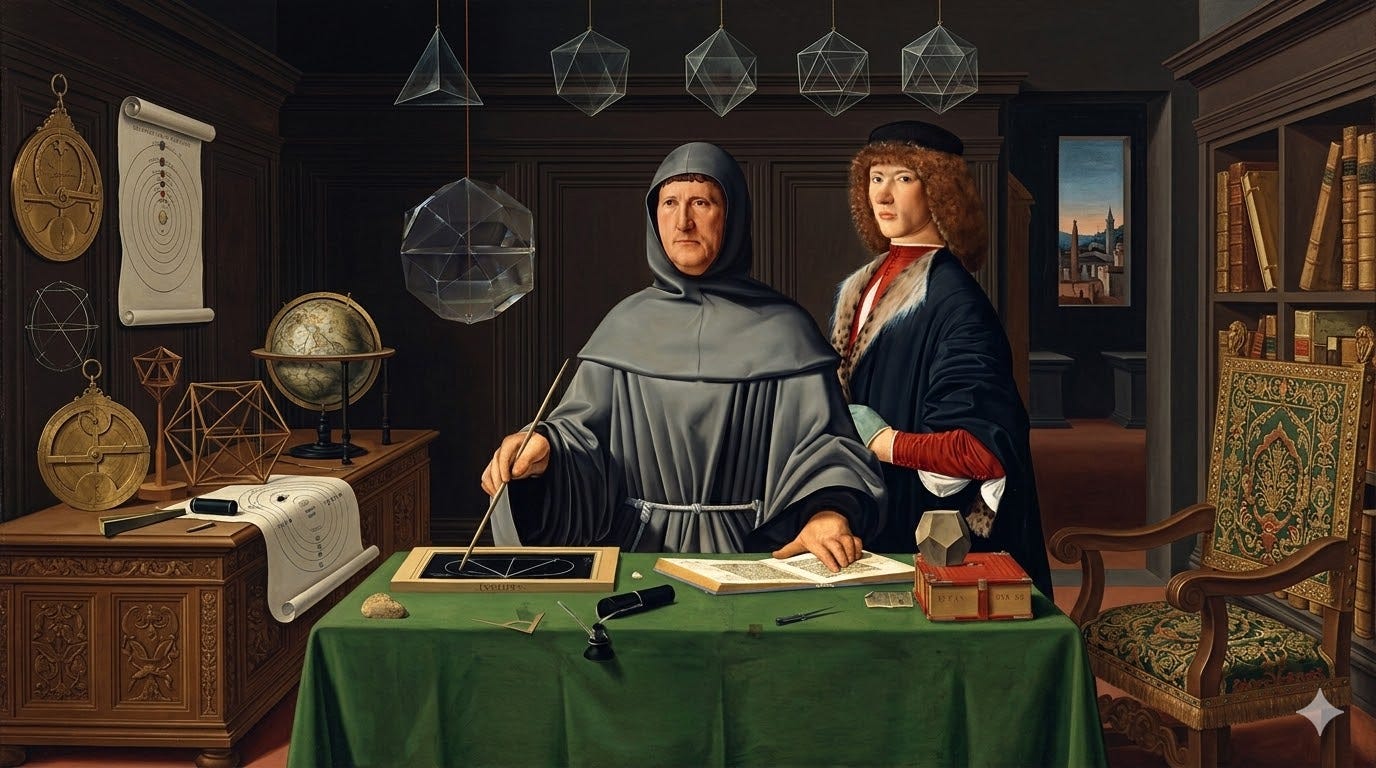
image: modified version of Portrait of Luca Pacioli

---
Excerpted from Magician and Mechanic (The Divine Self, Vol. 2): The Roots of “Spiritual but Not Religious” from the Renaissance to the Scientific Revolution by Michael Horton (Eerdmans, 2026). Used by permission.
In this second volume of The Divine Self series, Michael Horton explores changing conceptions of the divine self during the historic period from the Renaissance to the Scientific Revolution—a tumultuous era of rethinking humanity’s relationship to God and nature.
In Horton’s telling, this period is characterized not by steady diminishment of magic and orthodox religion and a corresponding rise of rational science, but rather by lively and productive interaction between these influences. Horton examines what is at stake for the divine self in this growing tension between magicians and Baconians, and what role each plays in the development of the modern self.
He analyzes the work of renowned historical figures—Luther, Erasmus, Descartes, and Hobbes, to name a few—but also illuminates the activities of lesser-known individuals and groups that were profoundly influential in their time. From the gardens of Renaissance popes and dukes to Newton’s alchemical pursuits, life during this period is characterized by an intense search for the sacred and a desire for fullness—forces that lay the groundwork for the “spiritual but not religious” phenomenon as we know it today.
Magician and Mechanic occupies an important place in a monumental three-volume study of the divine self. The first volume surveys antiquity through the late Middle Ages; the third volume (forthcoming) will span the eighteenth century through the present day. When the series is complete, The Divine Self will stand as the authoritative guide to the “spiritual but not religious” phenomenon in Western culture.
“Horton’s treatment is informed, reasonable, and impressively documented. Since one is hard pressed to understand our own time without better understanding our past, theologians, cultural critics, public intellectuals, and others will find his remarkable study both relevant and fascinating.”
— Kelly M. Kapic, Covenant College
“A marvelously engaging and eye-opening reassessment of the Western world’s transition to modernity. This second volume of Horton’s audacious trilogy on the ‘divine self’ assigns a leading role in this transitional process to spiritual enthusiasts and ancient philosophical and religious traditions—rather than to secularists—and in the process exposes the deeply theistic and mystical roots of dogmatic materialism and aggressive atheism. All in all, a stunning achievement.”
— Carlos Eire, Yale University
Find Magician and Mechanic at Eerdmans, Amazon, Barnes & Noble, and Books-A-Million.
*sponsored
Good essay.
God speaks truly without speaking technically.
That remains difficult for modern readers because modern people often assume:
technical precision = higher truth
phenomenological language = lower truth
But ordinary speech never works that way.
We still say:
sunrise
the sun went down
the weather changed
without implying geocentrism.
Great stuff here as I continue on my journey into spirituality/religious faith minus Man's spin on Christianity, Islam, etc.